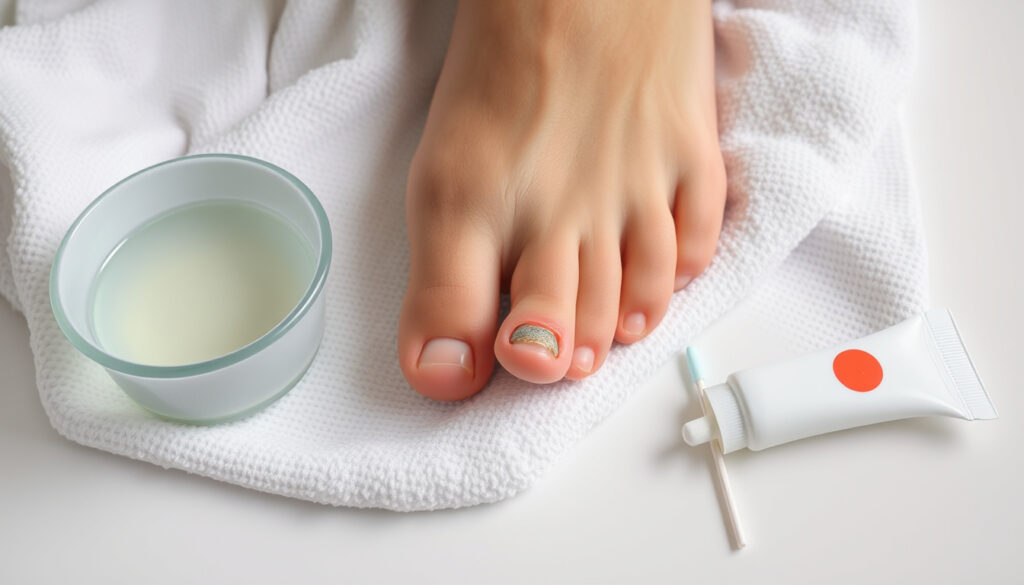
Ingrown Toenail Self-Care: Home Remedies and When to See a Doctor
Few things can turn a simple walk into a painful ordeal quite like an ingrown toenail, but if you’re dealing with that sharp, throbbing edge, you’re not alone — and most cases can be managed at home with the right steps. This guide walks you through evidence-based self-care, what to avoid, and the clear warning signs that mean it’s time to see a professional.
Soak solution: Warm, soapy water or Epsom salt ·
Soak frequency: 3–4 times daily ·
Soak duration: 10–20 minutes ·
Aftercare: Keep foot dry
Quick snapshot
- Soaking in warm water reduces swelling and pain (Mayo Clinic)
- Placing cotton under the nail lifts it and relieves pressure (Cleveland Clinic Health Essentials)
- Cutting nails straight across prevents ingrowth (Cedars-Sinai)
- Clinical effectiveness of Vaseline for ingrown toenails
- Most cases improve within 2–7 days of consistent self-care (Cedars-Sinai)
- If no improvement after 2–3 days, see a podiatrist (Mayo Clinic)
- Signs of infection require prompt medical attention (Cedars-Sinai)
Here’s a quick reference table of key facts about ingrown toenail self-care.
| Factor | Details |
|---|---|
| Common cause | Improper nail trimming (cutting too short or rounding edges) |
| Typical symptoms | Redness, swelling, pain along the nail edge |
| Self-care success rate | Most cases resolve with consistent home care (Mayo Clinic) |
| Highest risk group | Adolescents and young adults; people with diabetes |
How can I fix my ingrown toenail myself?
Four steps, one goal: reduce pressure, lift the nail, keep it clean. Here’s the sequence that major medical institutions recommend.
How do I cut an ingrown toenail at home?
- Soak first. Soak your foot in warm, soapy water or Epsom salt for 10–20 minutes, 3–4 times a day. This softens the skin and nail (Cleveland Clinic Health Essentials).
- Use sharp, straight clippers. Cut toenails straight across — never curve the edges. Cedars-Sinai emphasizes using clippers designed for toenails to avoid jagged edges (Cedars-Sinai).
- Don’t dig into the corners. Cutting the nail too short leaves soft flesh exposed, raising the risk of the nail growing into the skin (Cedars-Sinai).
How do I drain pus from an ingrown toenail?
If you see pus, that signals stage 2 infection. Do not try to drain it yourself. Cedars-Sinai warns that poking with sharp objects — what podiatrists call “bathroom surgery” — can push the infection deeper and may land you in the doctor’s office (Cedars-Sinai). See a podiatrist for proper drainage.
How can I get rid of an ingrown toenail overnight?
No reliable method eliminates an ingrown toenail overnight. However, a single warm soak followed by gently lifting the nail edge with a small piece of clean cotton (Cleveland Clinic Health Essentials) can reduce pressure quickly. Change the cotton daily. The real relief happens over 2–7 days with consistent care.
How can I fix an ingrown toenail permanently?
Permanent resolution often requires a medical procedure called partial nail avulsion, performed by a podiatrist. For mild cases, consistent self-care (proper cutting, cotton lifts) can prevent recurrence. Mayo Clinic notes that home care works for many, but if the problem returns, professional partial nail removal with chemical ablation offers a 95% success rate (Mayo Clinic).
What not to do with an ingrown toenail?
Three mistakes that routinely turn a minor nuisance into a clinical visit.
- Do not cut toenails too short. Cutting nails shorter than the tip of the toe leaves the skin vulnerable. Cedars-Sinai says this increases the risk of the nail growing into exposed skin (Cedars-Sinai).
- Do not wear tight shoes. Narrow toe boxes press the nail into the flesh. Cleveland Clinic Health Essentials recommends open-toed shoes or sandals while the toe heals (Cleveland Clinic Health Essentials).
- Do not ignore signs of infection. Redness spreading to the rest of the toe, warmth, pus, or a fever means the infection is moving beyond the nail fold. Mayo Clinic advises seeking care promptly (Mayo Clinic).
Why should you never ignore an ingrown toenail?
What starts as a mild ache can escalate to a serious infection called paronychia — a bacterial infection of the nail fold. Cedars-Sinai notes that pus discharge and severe swelling often require oral antibiotics (Cedars-Sinai). For people with diabetes or poor circulation, an untreated infection carries a risk of osteomyelitis or sepsis. Ignoring it means giving the infection time to spread.
A patient who avoids proper self-care because of fear or busyness faces two concrete consequences: a longer recovery (weeks instead of days) and a far higher probability of needing a minor surgical procedure. The catch is that the first 48 hours of good care buy the most leverage.
What does a stage 2 ingrown toenail look like?
Three stages, one risk gradient. Knowing where you are determines what you should do.
What are the three stages of an ingrown toenail?
Medical literature classifies ingrown toenails into three progressive stages:
- Stage 1 (mild): The nail edge presses into the skin. You see slight redness and swelling, but no drainage. Soaking and cotton lifts work well at this stage.
- Stage 2 (infected): The skin breaks, bacteria enter. Swelling increases, pain sharpens, and pus or clear discharge appears. Cedars-Sinai warns this stage may require oral antibiotics (Cedars-Sinai).
- Stage 3 (chronic): Granulation tissue — a red, moist overgrowth of skin — forms along the nail fold. The toe looks “meaty” around the nail. This stage almost always needs professional treatment, often partial nail removal.
The implication: Stage 1 is a self-care window; stage 2 is a yellow light — see a doctor; stage 3 is a red light — medical treatment is expected.
What draws an ingrown toenail out?
Several home remedies claim to lift the nail and reduce pressure. Here’s what the evidence says about the most common ones.
Why does vaseline help ingrown toenails?
Vaseline (petroleum jelly) softens the skin around the nail fold, which can reduce friction and irritation. Cleveland Clinic Health Essentials mentions petrolatum ointment as an option after soaking, before bandaging (Cleveland Clinic Health Essentials). However, the clinical evidence for Vaseline specifically lifting the nail is weak — it is a moisturizer, not a nail-lifting agent.
What does Vicks VapoRub do for an ingrown toenail?
Vicks VapoRub contains camphor, menthol, and eucalyptus oil — ingredients with mild antimicrobial and analgesic properties. Some people apply it to reduce pain and lower infection risk. No high-quality studies confirm its effectiveness for ingrown toenails, and Cleveland Clinic Health Essentials notes that such remedies are popular but unproven (Cleveland Clinic Health Essentials).
The catch: Vaseline and Vicks can soften skin and possibly soothe irritation, but they do not mechanically lift the nail. For pressure relief, the physical lift from a cotton or dental floss wick under the nail edge is the method with the strongest institutional support (Mayo Clinic).
Will I get sepsis from an ingrown toenail?
Rare, but possible. The risk is real for certain groups.
- Sepsis is rare but possible if an infection from the toe spreads to the bloodstream. Cedars-Sinai emphasizes that a severe infection (paronychia) needs prompt care to prevent systemic spread (Cedars-Sinai).
- Signs of infection include spreading redness, warmth, pus, and fever. If you have a fever, see a doctor immediately.
- Higher-risk individuals: People with diabetes, peripheral artery disease, or a compromised immune system face a higher chance of the infection moving beyond the toe. Mayo Clinic advises these groups to seek medical evaluation early (Mayo Clinic).
Confirmed facts
- Soaking in warm water reduces swelling and pain
- Placing cotton under the nail lifts it and relieves pressure
- Tight footwear worsens the condition
What’s unclear
- Clinical effectiveness of Vaseline for ingrown toenails
- Antimicrobial benefit of Vicks VapoRub in this context
- Optimal duration for cotton placement
“Home care may include soaking the foot and placing cotton or dental floss under the nail edge.”
— Mayo Clinic (leading academic medical center)
“If there is no discharge, pus, or similar sign of infection, Epsom salt soaks for 20 minutes can help.”
— Cedars-Sinai (nonprofit academic health system)
“Do not attempt ‘bathroom surgery’ with sharp objects — it could land someone in the doctor’s office.”
— Cedars-Sinai
“Self-treatment should be reconsidered if it fails; see a podiatrist.”
— Cleveland Clinic Health Essentials (top-ranked hospital network)
Ingrown toenails are one of those common problems that feel too small for a doctor visit but too painful to ignore. The evidence-based approach is clear: start with warm soaks, cotton lifts, and proper trimming. That works for most people in days. But if you have diabetes, a compromised immune system, or signs of infection (pus, spreading redness, fever), the safe move is to see a podiatrist early. For the person who catches it at stage 1, the choice is between a week of self-care and a clinic procedure. The path you choose determines whether you’re walking comfortably in two days or two weeks.
mifootankle.com, ankle-footspecialist.com, thirdcoastfoot.com, healthline.com, myhealth.alberta.ca, healthy.kaiserpermanente.org
If home soaks and cotton lifts aren’t enough, proven overnight treatments for ingrown toenails provides additional proven methods for faster relief.
Frequently asked questions
Can an ingrown toenail heal on its own?
Mild cases (stage 1) can heal on their own if the nail naturally grows out and the pressure is relieved. However, most people benefit from active self-care to speed healing and reduce pain. Stage 2 and stage 3 infections rarely resolve without intervention.
How long does it take for an ingrown toenail to heal?
With consistent home care — soaks and cotton lifts — improvement is often seen in 2–7 days. Full healing may take 1–3 weeks depending on severity. If infection is present, healing takes longer and may require antibiotics or a minor procedure.
Can I walk with an ingrown toenail?
Yes, but choose footwear wisely. Wear open-toed shoes or sandals to avoid pressure on the toe. Avoid tight shoes and high heels until the toe has healed. Pain may limit walking, but it’s not dangerous.
What is the best pain relief for an ingrown toenail?
Over-the-counter pain relievers like ibuprofen or acetaminophen can help. Warm soaks also provide natural pain relief by reducing swelling. Topical numbing creams may offer temporary relief but should not replace proper nail care.
Is it safe to remove an ingrown toenail at home?
No. Attempting to cut or pull out the nail yourself can cause bleeding, infection, and permanent nail damage. Always see a podiatrist for nail removal, especially if the condition is chronic or infected.
Can an ingrown toenail come back after treatment?
Yes, recurrence is common — up to 70% of cases return after simple nail trimming if the underlying cause (improper cutting, tight shoes, nail shape) is not addressed. Partial nail avulsion with chemical ablation reduces recurrence to about 5%.
More related posts
 Alison Hammond: Weight Loss, Net Worth & Relationship
 No Limits Removalists Reviews: Customer Feedback Analysis
 Allana Ferguson: Age, Height, Husband, Kids & Rugby Career (2025)
 Classics for a Cause – 2025 Car Raffle Details and Guide
 Jackson Pollock: Biography, Art, and Death of a Pioneer
 Peripheral Neuropathy Symptoms: Warning Signs & Stages
 Joel Madden: Biography, Family, Wife, Net Worth, and Career Facts
 Lily Mo Sheen: Age, Movies, Parents Michael Sheen & Kate Beckinsale