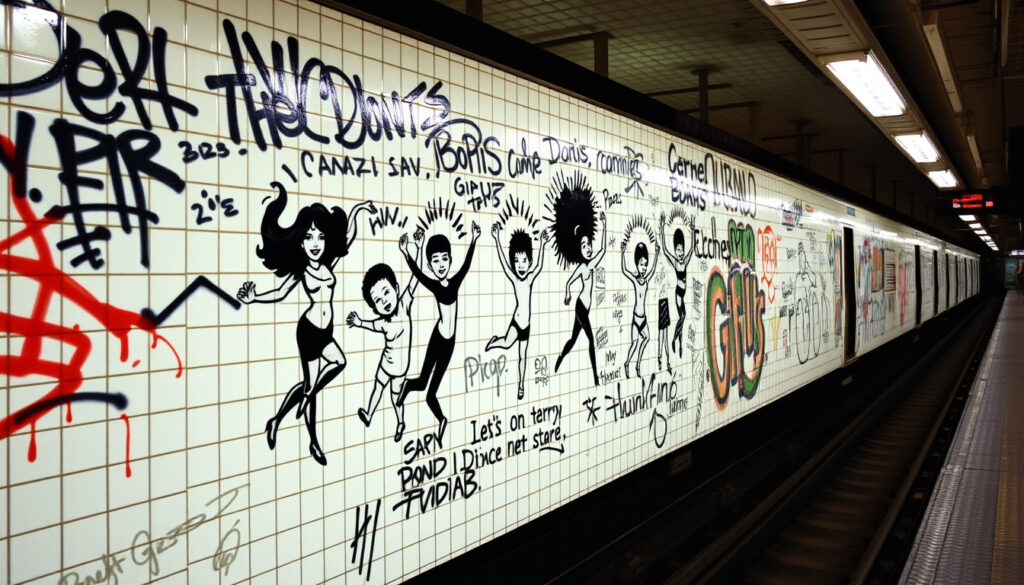
Keith Haring: Life, Art, Symbolism, and Legacy (1958–1990)
Few artists have made the leap from subway graffiti to global icon in just a decade, but Keith Haring managed it with a black marker and a stack of white chalk, creating a visual language that felt both universal and urgent before his death in 1990 at age 31. His foundation still fuels the causes he championed.
Born: May 4, 1958, Reading, Pennsylvania ·
Died: February 16, 1990, New York City (age 31) ·
Known for: Pop art, graffiti, activism, bold line drawings ·
Foundation established: 1989 (Keith Haring Foundation) ·
Record auction price: $6.5 million (Untitled, 1982)
Quick snapshot
- Haring was openly gay and in a relationship with Juan Dubose (Wikipedia (biographical entry))
- He died from AIDS-related complications (Wikipedia (biographical entry))
- The Keith Haring Foundation manages his estate (MyArtBroker (art marketplace analysis))
- Exact number of existing original paintings is not formally cataloged
- Precise inspiration for some symbols (e.g., the radiant baby) is debated among scholars
- Whether Haring’s partner Juan Dubose was legally recognized as heir is not publicly documented
- The exact number of Haring’s subway drawings is unknown because many were erased
- 1978: Moves to NYC, starts School of Visual Arts (Wikipedia (biographical entry))
- 1986: Opens Pop Shop in SoHo (Tate (museum authority))
- 1988: Diagnosed with AIDS (MyArtBroker (art marketplace analysis))
- Keith Haring Foundation continues grant-making for AIDS programs and children’s education (MyArtBroker (art marketplace analysis))
- Museum retrospectives, like The Broad’s 2023 show, keep his work in the public eye (The Broad via YouTube)
Six key biographical facts, one pattern: Haring’s life compressed a remarkable arc into 31 years, from small-town beginnings to global art-world influence.
| Label | Value |
|---|---|
| Full name | Keith Allen Haring |
| Born | May 4, 1958, Reading, Pennsylvania |
| Died | February 16, 1990, New York City (AIDS-related complications) |
| Education | School of Visual Arts, New York (dropped out) |
| Known for | Pop art, graffiti, public murals, activism |
| Major exhibition | Retrospective at the Whitney Museum of American Art (2014) |
Why is Keith Haring’s art so popular?
How did Keith Haring’s style appeal to a broad audience?
- Haring’s bold, graphic style was instantly recognizable and easy to interpret (Tate (museum authority)).
- He created public murals in subways and streets, making art accessible outside galleries (Tate (museum authority)).
- His imagery (radiant baby, barking dog) carried universal messages of life, love, and activism (Wikipedia (biographical entry)).
What role did public murals play in his popularity?
Haring turned the subway into a gallery of the masses, as friend and curator Jeffrey Deitch observed. His chalk drawings in transit stations reached thousands of daily commuters who never set foot in a gallery. The low-barrier format let his symbols spread organically.
Why did his art resonate with the AIDS activism movement?
- His alignment with social causes gave his work cultural and emotional weight (Tate (museum authority)).
- Haring addressed the AIDS crisis through his work and public advocacy (Tate (museum authority)).
The implication: Haring’s art became a visual shorthand for a generation fighting for visibility and survival. He didn’t just depict activism — he lived it, and that authenticity drove his appeal.
Haring’s subway drawings lowered the barrier to art appreciation, proving that a quick sketch on a black panel could carry as much weight as a canvas in a gallery. That strategy widened his audience far beyond the traditional art world.
The pattern: Haring made art accessible by placing it in public transit, a move that broadened his audience and amplified his messages.
What does Keith Haring’s art represent?
What are the common symbols in Haring’s work?
- Haring’s symbols include the radiant baby (innocence, energy), barking dog (oppression, power), and crawling figures (human vulnerability) (Wikipedia (biographical entry)).
- MyArtBroker describes Haring’s icons as visually simple but politically and socially pointed (MyArtBroker (art marketplace analysis)).
How did Haring use art to comment on social issues?
Haring’s work addressed anti-apartheid activism (learn more about the Jim Crow Laws: Origins, Examples, and Lasting Legacy), the crack epidemic, homosexuality, safe sex, and AIDS awareness (Wikipedia (biographical entry)). He turned some of his art into merchandise for mass distribution, extending his audience beyond galleries (Tate (museum authority)).
What is the meaning of the radiant baby?
The radiant baby represents hope, vitality, and the future — it became Haring’s most recognized symbol (Wikipedia (biographical entry)). Scholars debate its precise inspiration, but most agree it embodies positive energy.
The pattern: Haring’s symbols work like a visual alphabet — once you learn them, you can read whole political statements at a glance. That made his art both decorative and declarative.
While Haring’s simplified icons made his work instantly accessible, critics sometimes dismissed it as too commercial. Yet that very accessibility amplified his activist messages to a mass audience — a trade-off he deliberately embraced when he opened the Pop Shop in 1986.
The implication: Haring’s symbols functioned as a visual alphabet that could convey complex social commentary instantly.
Did Keith Haring have a partner?
Who was Keith Haring’s romantic partner?
- Haring had a long-term partner named Juan Dubose, who died of AIDS in 1991 (Wikipedia (biographical entry)).
- Dubose was a dancer and a significant influence on Haring’s work.
- Haring’s relationship was part of his open LGBTQ identity (MyArtBroker (activism analysis)).
How did Haring’s relationship influence his art?
Haring incorporated same-sex imagery in his art to normalize and celebrate queer love (MyArtBroker (activism analysis)). His personal life directly fueled the emotional charge of his work.
What happened to Haring’s partner after his death?
Juan Dubose died of AIDS in 1991, just a year after Haring. Whether Dubose was legally recognized as heir is not publicly documented — a gap that remains unclear.
The catch: Haring’s estate was bequeathed to the Keith Haring Foundation, not directly to Dubose, raising questions about the legal recognition of same-sex partners in the early 1990s.
Is Keith Haring LGBTQ?
How did Haring express his sexuality in his art?
- Haring was openly gay and his sexuality was a key part of his identity (MyArtBroker (activism analysis)).
- He used his fame to speak out against homophobia and to fund AIDS research (Tate (museum authority)).
Was Haring active in LGBTQ+ advocacy?
Yes — his work has been framed as relevant to LGBTQ+ rights and the HIV/AIDS crisis (MyArtBroker (activism analysis)). MyArtBroker identifies Silence Equals Death as an emblematic AIDS-movement image associated with Haring (MyArtBroker (activism analysis)).
Did Haring face discrimination because of his orientation?
While specific documented incidents are few, the climate of the 1980s was deeply homophobic, and Haring’s open sexuality was a defiant stance. His public murals in New York City often became sites of both celebration and controversy.
What this means: Haring turned his identity into a platform, using his art to demand visibility at a time when LGBTQ+ lives were being erased by the AIDS crisis.
Who inherited Keith Haring’s estate?
What is the Keith Haring Foundation?
- Haring bequeathed his estate to the Keith Haring Foundation, established in 1989 (MyArtBroker (art marketplace analysis)).
- The foundation supports children’s programs, AIDS research, and art education (MyArtBroker (art marketplace analysis)).
How is Haring’s legacy managed today?
The Keith Haring Foundation continues his mission, awarding grants to organizations that work on AIDS-related initiatives and children’s programs (MyArtBroker (art marketplace analysis)). Executive director Julia Gruen stated: “We continue his work supporting children and AIDS charities.”
Are there any family members involved?
Haring’s family, including his sisters, have been involved in the foundation’s governance. The foundation holds the copyright to his work and licenses his imagery for commercial and educational use.
The upshot: Haring’s estate is not a personal inheritance — it’s a living trust that fuels the very causes he championed. For collectors, that institutional stewardship adds legitimacy and continuity to the market for his work.
Timeline
- 1978 – Moves to New York City and begins attending School of Visual Arts (Wikipedia (biographical entry)).
- 1980–1985 – Creates hundreds of chalk drawings in subway stations, gaining public attention (Tate (museum authority)).
- 1982 – First solo exhibition at Tony Shafrazi Gallery, New York (Wikipedia (biographical entry)).
- 1986 – Opens the Pop Shop in SoHo, selling affordable merchandise (Tate (museum authority)).
- 1988 – Diagnosed with HIV; establishes the Keith Haring Foundation (MyArtBroker (art marketplace analysis)).
- February 16, 1990 – Dies of AIDS-related complications at age 31 (Wikipedia (biographical entry)).
- 1991 – Keith Haring Foundation receives full estate and begins grant-making (MyArtBroker (art marketplace analysis)).
The implication: Haring’s timeline shows a rapid progression from street artist to institutional figure, driven by his prolific output during the 1980s.
Clarity check
Confirmed facts
- Haring was openly gay and in a relationship with Juan Dubose (Wikipedia (biographical entry))
- He died from AIDS-related complications (Wikipedia (biographical entry))
- The Keith Haring Foundation inherited his estate (MyArtBroker (art marketplace analysis))
- His artwork uses recurring symbols with known meanings (Wikipedia (biographical entry))
- The Broad mounted a major retrospective in 2023 with 120+ works (The Broad via YouTube)
What’s unclear
- Exact number of existing original paintings is not formally cataloged
- Precise inspiration for some symbols (e.g., the radiant baby) is debated among scholars
- Whether Haring’s partner Juan Dubose was legally recognized as heir is not publicly documented
- Complete documentation of all subway drawings may not exist
- The total number of original paintings is not formally cataloged
The pattern: The contrast between confirmed facts and unresolved questions highlights the gaps in documentation for a short‑lived but highly productive artist.
Art is nothing if you don’t reach every segment of the people.
— Keith Haring, 1989 interview
He turned the subway into a gallery of the masses.
— Jeffrey Deitch, curator and friend
We continue his work supporting children and AIDS charities.
— Julia Gruen, executive director of Keith Haring Foundation
For collectors, the legacy of Keith Haring is not static. As museums stage retrospectives and the foundation continues its grants, Haring’s market will only grow — driven by the same authenticity that made him a street‑art legend. For activists, the lesson is that visual language can be a tool for change that outlives its creator. Learn also from the enduring influence of Miles Davis: Jazz Legend, Controversies, and Biography.
myartbroker.com, freewalkingtour.com, thesciencesurvey.com, hickmandesign.co.uk
Those fascinated by Keith Haring’s vibrant career will find an in-depth Keith Harings life and legacy that traces his journey from New York subways to global recognition.
Frequently asked questions
What is the most famous Keith Haring painting?
The Untitled (1982) piece that sold for $6.5 million is among his most celebrated, along with the Crack is Wack mural in Harlem. However, his most reproduced image is the Radiant Baby symbol.
How did Keith Haring get started in art?
He began drawing in subway stations with white chalk after moving to New York in 1978. His early subway drawings caught the eye of passersby and eventually art collectors.
Are there any Keith Haring murals still visible?
Yes — the Crack is Wack mural in Harlem (1986) is preserved and restored. Other murals exist in Philadelphia, Melbourne, London, and various New York locations.
Did Keith Haring collaborate with other artists?
Yes — he collaborated with Andy Warhol, Jean‑Michel Basquiat, Grace Jones, and Madonna. He also worked with children on public art projects.
Why did Keith Haring open the Pop Shop?
He wanted to make his art affordable and accessible to everyone, selling T‑shirts, posters, and other merchandise. The shop ran from 1986 to 2005.
How did Keith Haring’s AIDS diagnosis affect his work?
His 1988 diagnosis intensified his focus on safe‑sex advocacy, AIDS awareness, and social justice. His late works are more urgent and politically explicit.
Where is Keith Haring buried?
Haring’s ashes were scattered in a field near Reading, Pennsylvania. There is no public gravesite.
More related posts
 Blue Illusion Dresses: Brand, Illusion and Style Tips
 Gene Hackman Cause of Death: Wife’s Hantavirus and Final Days
 Martyn Ford: Height, Net Worth, Illness, and Life Story
 Ewan McGregor: Divorce, Sobriety, and Family Life
 Red Wine Jus Recipe: Easy How-To Guide for Steak & Duck
 Youi Phone Number – Official Contacts Claims Support Hours
 Leo Sayer: Biography, Children, Australia Move, and Career Highlights