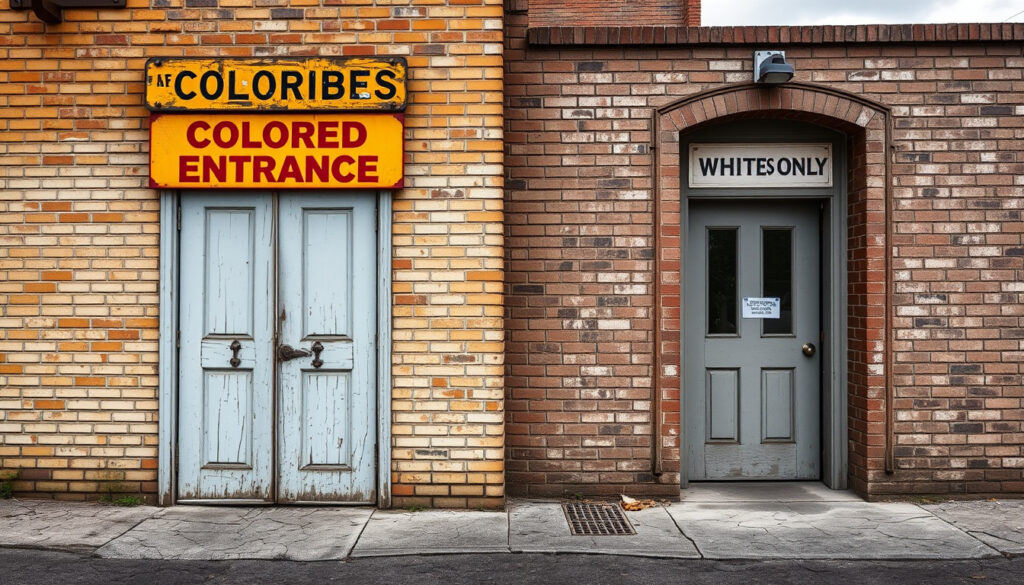
Jim Crow Laws: Origins, Examples, and Lasting Legacy
Few systems of law have shaped a society as profoundly — or as painfully — as the Jim Crow laws that governed the American South for nearly a century. The term itself began as a minstrel show character in the 1830s, but it came to represent a brutal system of racial segregation backed by state power. Here we trace the origins, the laws, the resistance, and the end of Jim Crow, and we look at how its legacy connects to the way we understand racism today.
Years of Jim Crow laws: 1877 to 1965 · Number of Southern states with Jim Crow laws: 17 · Landmark Supreme Court case: Plessy v. Ferguson (1896) · Key ending legislation: Civil Rights Act of 1964 and Voting Rights Act of 1965 · Original term source: 1830s minstrel show character
Quick snapshot
- System of racial segregation laws (Wikipedia)
- Enforced in Southern states, 1877–1965 (National Park Service)
- Created second-class citizenship for African Americans (Jim Crow Museum)
- Derived from blackface minstrel character (Britannica)
- Performed by Thomas D. Rice in the 1830s (Britannica)
- Name became shorthand for segregation (Wikipedia)
- Separate public schools, restrooms, water fountains (National Park Service)
- Poll taxes and literacy tests for voting (Britannica)
- Anti-miscegenation laws (Jim Crow Museum)
- Brown v. Board of Education (1954) (Wikipedia)
- Civil Rights Act of 1964 (Wikipedia)
- Voting Rights Act of 1965 (Wikipedia)
The data below provides a concise overview of Jim Crow’s legal framework.
| Time period | 1880s–1960s (peak 1890s–1930s) |
|---|---|
| Legal basis | Separate but equal (Plessy v. Ferguson) |
| Key tactics | Poll taxes, literacy tests, segregation in all public facilities |
| Number of states | Approximately 17 (all former Confederate states plus border states) |
| Ending legislation | Civil Rights Act of 1964, Voting Rights Act of 1965 |
What does it mean to be called a Jim Crow?
The phrase “Jim Crow” carries a double legacy: it refers to a fictional minstrel character and, more consequentially, to the system of racial segregation that defined the American South for nearly a century. When used as a label for a person, it was a racial slur — a way to demean African Americans by linking them to a degrading caricature (Britannica). The term quickly became shorthand for segregation itself, and to be called a “Jim Crow” was to be reminded of the enforced second-class status that the laws created.
Why was it called Jim Crow?
- The name comes from a minstrel show song “Jump Jim Crow” first performed by Thomas Dartmouth Rice in 1828 (Britannica).
- Rice, a white actor, performed in blackface, singing and dancing in a manner that caricatured Black Americans (Wikipedia).
- By the 1870s, the term “Jim Crow” was being used to label the segregation laws that were emerging after Reconstruction (National Park Service).
The implication is clear: a degrading pop-culture symbol became the name for a degrading legal system. The triviality of the character’s origin stands in stark contrast to the weight of the laws it came to represent.
Who was Jim Crow?
Jim Crow was never a real person. He was a fictional character — a clumsy, exaggerated blackface figure performed by white entertainer Thomas D. Rice. The character first appeared around 1830 and became enormously popular, cementing the “Jim Crow” persona in American popular culture (Britannica).
“The invention of Jim Crow was not an accident; it was a deliberate creation of a degrading image that made segregation seem natural.”
— C. Vann Woodward, historian, author of The Strange Career of Jim Crow (Wikipedia)
Over time, the name detached from the entertainer and attached itself to the entire apparatus of segregation. The character’s name was used to label the legal codes that stripped Black Americans of their rights, a transition that scholars at the Jim Crow Museum (Ferris State University) describe as the “folkloric labeling of a caste system.”
What is the Jim Crow character?
- The character “Jim Crow” was a blackface minstrel routine in which Rice sang “Jump Jim Crow” and performed a dance (Britannica).
- The song included the line “Wheel about, and turn about, and do just so / Every time I wheel about, I jump Jim Crow” (Wikipedia).
- The performance relied on offensive stereotypes — lazy, buffoonish, happy-go-lucky — that white audiences found entertaining (Jim Crow Museum).
A fictitious stage act became the legal identity for an entire race. The name “Jim Crow” did not describe a reality — it invented one, and the law made it stick.
Was Jim Crow apartheid?
Jim Crow laws and South African apartheid both enforced racial segregation through state power, but they differed in legal structure and timing. Apartheid, instituted in 1948, created a rigid racial classification system with pass laws, residential segregation, and separate political structures (Wikipedia). Jim Crow, by contrast, was a patchwork of state and local segregation statutes that focused on public facilities and social separation without formal racial ID cards.
| Feature | Jim Crow laws | South African apartheid |
|---|---|---|
| Time period | 1877–1965 | 1948–1994 |
| Legal basis | “Separate but equal” (state laws, Supreme Court upheld) | Population Registration Act, Group Areas Act, pass laws |
| Scope of segregation | Public facilities, schools, transportation, marriage | All aspects of life, including land ownership, employment, and political rights |
The pattern is clear: both systems shared the goal of racial subordination, but apartheid was more centrally codified and lasted longer. Historian C. Vann Woodward noted that Jim Crow was “less systematic but no less oppressive” than apartheid (Wikipedia).
What finally ended Jim Crow?
The dismantling of Jim Crow came through a combination of legal challenges, legislative action, and mass protest. The Supreme Court’s Brown v. Board of Education (1954) struck down school segregation, and the Civil Rights Act of 1964 outlawed segregation in public accommodations. The Voting Rights Act of 1965 eliminated the discriminatory practices that had kept Black citizens from the polls (Wikipedia).
“The arc of the moral universe is long, but it bends toward justice.”
— Martin Luther King Jr., speech in Montgomery, Alabama, 1965 (The King Institute)
Yet the end of legal Jim Crow did not erase its effects. The system had embedded racial inequality into housing, education, and wealth — structures that persist today. As the Jim Crow Museum explains, the end of de jure segregation left de facto inequality that required further intervention.
What years did Jim Crow laws exist?
- Jim Crow laws were enacted after the Compromise of 1877, which ended federal Reconstruction (Wikipedia).
- They remained in force until the mid-1960s, with the last formal laws struck down by 1968 (Georgia College & State University).
- Some scholars periodize Jim Crow from 1880 to 1965, with the peak of new laws between 1890 and 1910 (Britannica).
The legal dismantling was a victory, but the structural damage required generations to mend.
What are the 4 levels of racism?
To understand how Jim Crow operated, it helps to look at racism through a four-level framework. Sociologists often distinguish between internalized, interpersonal, institutional, and structural racism. Each level was present in the Jim Crow South:
- Internalized racism — Black Americans internalized the message of inferiority that the system broadcast.
- Interpersonal racism — Everyday acts of discrimination and violence, from segregated lunch counters to lynchings.
- Institutional racism — Laws and policies that explicitly discriminated (schools, voting, housing).
- Structural racism — The interaction of institutions that produced cumulative disadvantage across generations.
Jim Crow was a textbook case of institutional and structural racism working together. The National Park Service notes that the segregation laws “touched every aspect of life” and were reinforced by economic exploitation and social custom.
The four-level framework shows that even after the laws were gone, structural racism remained — because it had accumulated decades of unequal wealth, housing, and education. Jim Crow didn’t just discriminate in the moment; it built inequality into the architecture of society.
Understanding these layers reveals why the end of Jim Crow law did not mean the end of racial inequality.
What did Abraham Lincoln say about Black people?
Abraham Lincoln’s views on race have been the subject of debate for generations. During the 1858 Lincoln-Douglas debates, he stated he did not believe in racial equality in social and political spheres, and he supported the colonization of freed slaves to Africa or Central America (National Park Service). However, his position evolved. By 1863 he issued the Emancipation Proclamation, and he pushed for the 13th Amendment to abolish slavery.
“I am not, nor ever have been, in favor of bringing about in any way the social and political equality of the white and black races.”
— Abraham Lincoln, debate with Stephen Douglas, 1858 (National Park Service)
Historians at the National Park Service emphasize that Lincoln’s thinking was complex and shaped by political constraints. His later support for emancipation and the 13th Amendment represented a dramatic shift, but earlier statements continued to be used by segregationists to justify Jim Crow.
The implication: Lincoln’s legacy is a reminder that individual leaders can embody the same contradictions built into the system. His views changed, but the society that followed his presidency did not — until the civil rights reforms of the 1960s.
Lincoln’s contradictions mirror the nation’s struggle with race.
Timeline of Jim Crow laws
- 1877 — End of Reconstruction; Southern states begin enacting segregation laws (Wikipedia).
- 1896 — Plessy v. Ferguson: Supreme Court upholds “separate but equal” (Wikipedia).
- 1900–1920 — Height of Jim Crow; literacy tests and poll taxes disenfranchise Black voters (Britannica).
- 1954 — Brown v. Board of Education strikes down school segregation (Wikipedia).
- 1964 — Civil Rights Act of 1964 outlaws segregation in public accommodations (Wikipedia).
- 1965 — Voting Rights Act of 1965 eliminates discriminatory voting practices (Wikipedia).
The timeline shows legal progress, but the gap between 1877 and 1965 means that three generations lived under Jim Crow. The inequality accumulated over those years was not erased by the legislation — it became structural.
The timeline underscores that legal change alone cannot erase accumulated disadvantage.
Confirmed facts
- Jim Crow laws were formally in place from the end of Reconstruction until the mid-1960s (Wikipedia).
- The term originated from a minstrel show character performed by Thomas D. Rice (Britannica).
- Plessy v. Ferguson (1896) established the “separate but equal” doctrine (Wikipedia).
- The Civil Rights Act of 1964 and Voting Rights Act of 1965 ended legal Jim Crow (Wikipedia).
What’s unclear
- The exact total number of individual Jim Crow laws passed across states.
- Whether some laws were de facto rather than de jure in certain areas.
- The precise origin of the phrase “Jim Crow” beyond the minstrel character.
- The exact number of states that enforced Jim Crow laws is debated depending on whether border states are included.
Related reading
- The Fall of the Berlin Wall: Causes, Events and Legacy — The Berlin Wall is another example of a political barrier that divided people by law and was eventually torn down by popular will.
- Polling Booth Near Me – Find Your Voting Location Fast — Know your voting rights and access today, a freedom that was denied under Jim Crow.
Frequently asked questions
How did Jim Crow laws affect voting?
Jim Crow laws used poll taxes, literacy tests, property requirements, and grandfather clauses to disenfranchise African American voters. In some states, Black voter turnout dropped to near zero (Britannica).
Which political party supported Jim Crow laws?
After the 1870s, the Democratic Party in the South was the primary force behind Jim Crow laws. The Republican Party at the national level supported civil rights, though Southern Republicans also sometimes accommodated segregation (Wikipedia).
What are examples of Jim Crow laws?
Examples include separate public schools, water fountains, restrooms, and seating on trains; anti-miscegenation laws; and laws barring Black people from parks, theaters, and cemeteries. In Birmingham, Alabama, it was illegal for Black and White people to play checkers together (Jim Crow Museum).
What are the 7 types of racism?
Beyond the four levels, scholars sometimes break racism into seven types: internalized, interpersonal, institutional, structural, cultural, historical, and systemic. Each type was visible under Jim Crow — for example, cultural racism was expressed through minstrel shows that shaped White perceptions (Britannica).
Did Irish people experience racism?
Irish immigrants in the 19th century faced discrimination from Anglo-American Protestants, including “No Irish Need Apply” signs and negative stereotypes. However, Irish people were legally considered White and could access the privileges of whiteness that were denied to African Americans under Jim Crow (Wikipedia).
What does the term ‘Jim Crow’ mean?
“Jim Crow” originally referred to a blackface minstrel character from the 1830s. By the 1870s, it became a shorthand for the system of racial segregation and discrimination laws in the Southern United States (Britannica).
Jim Crow laws were not merely a set of statutes — they were the legal skeleton of a caste system that persisted for nearly 90 years. For the African American community, the cost was measured in lost votes, lost education, lost lives, and lost generational wealth. The implication for today is clear: dismantling the laws did not dismantle the inequality they produced. That work remains unfinished.
More related posts
 Steve Carell: Is He Really a Nice Guy in Real Life
 SBW vs Gallen Fight Card: Results and Scorecard
 Shirley MacLaine: Love Life, Family, and Career Facts
 The Lovely Bones: Answers to Top Questions About the Movie & Book
 Sofia Carson: Who She’s Dating, Her Ethnicity & Career
 Ace Hoyts Midland Gate: Showtimes, Tickets, Discounts Guide
 Martyn Ford: Height, Net Worth, Illness, and Life Story
 Margaret River Chocolate Factory: Free Entry, Hour & Ta ting