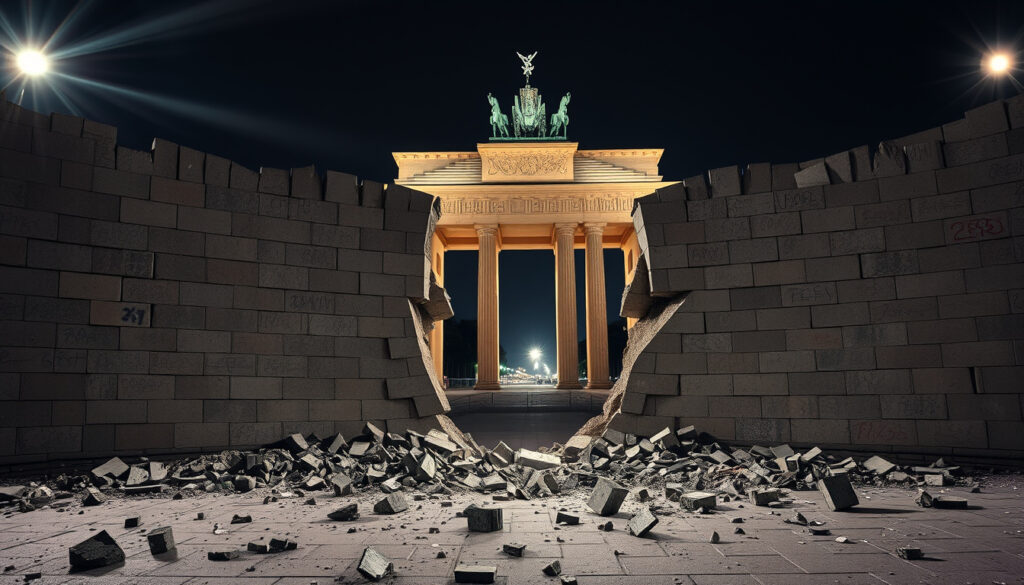
The Fall of the Berlin Wall: Causes, Events and Legacy
By November 1989, most Berliners had accepted that the Wall would outlast them. It had stood for nearly three decades, a slab of concrete and razor wire cutting a city in half — and anyone who tried to cross it without permission knew the risks. Then, on a Thursday evening, a single confused announcement at a press conference changed everything, and thousands of people simply walked across.
Date of Fall: November 9, 1989 · Location: Berlin, Germany · Key Event Trigger: Peaceful Revolution protests · Wall Length: 155 km · Lives Lost at Wall: At least 140
Quick snapshot
- The Wall fell on November 9, 1989 (Wikipedia)
- It stood for 28 years, built August 13, 1961 (Stiftung Berliner Mauer)
- The exact minute the first checkpoint opened to the crowd (historians continue to debate exact timing)
- Whether border guard commanders received any advance orders that evening (records remain incomplete)
- Hungary opened its border with Austria on August 23, 1989, letting East Germans flee west (Preceden timeline)
- Mass protests erupted in Leipzig through autumn 1989 (Preceden timeline)
- Germany reunified on October 3, 1990 (Wikipedia entry on the fall)
- The Soviet Union dissolved in 1991 following regional shifts (Wikipedia entry on the fall)
Key facts about the Wall’s construction, fall, and aftermath appear in the summary table below.
| Fact | Detail |
|---|---|
| Fall Date | November 9, 1989 |
| Announcement Time | Evening press conference |
| President | George H.W. Bush |
| Wall Built | August 13, 1961 |
| Wall Duration | 28 years |
| Reagan Speech | June 12, 1987 at Brandenburg Gate |
| Kennedy Speech | June 26, 1963 |
| Reunification | October 3, 1990 |
What caused the downfall of the Berlin Wall?
The Berlin Wall did not fall because one person decided it should. It fell because a combination of pressures — economic, political, and social — had made it untenable for years, and because a single miscommunication on November 9, 1989, opened a window that nobody bothered to close.
Protests and Peaceful Revolution
Beginning in September 1989, thousands of East Germans fled through Hungary after Budapest opened its border with Austria on August 23, 1989. The exodus exposed just how hollow the GDR’s official narrative had become. By October, weekly demonstrations in Leipzig drew an estimated 300,000 to 700,000 participants calling for political reform, according to multiple historical accounts.
The regime that built the Wall to stop people from leaving had already lost control long before the checkpoints opened. East German officials found themselves unable to explain why the borders suddenly had to be closed.
Political pressures in East Germany
Soviet leader Mikhail Gorbachev’s glasnost reforms had emboldened dissidents across Eastern Europe, and the East German leadership under Erich Honecker found itself out of step with its own superpower patron. When protests intensified in autumn 1989, party officials debated travel reforms — but nobody agreed on timing or scope. That indecision proved decisive.
Who knocked down the Berlin Wall?
No single person knocked down the Berlin Wall. What happened on the night of November 9 was more accidental than heroic — the product of a confused announcement and thousands of ordinary people who showed up at checkpoints when they heard they could cross.
The opening on November 9
During an evening press conference on November 9, 1989, East German official Günter Schabowski was handed a note announcing new travel regulations. When journalists asked when the new rules would take effect, Schabowski — who had not been present for the policy meeting — reportedly shrugged and said the regulations were effective immediately, according to History Cooperative analysis. The press conference was broadcast live on East German television.
Crowds and border guards
Within hours, thousands of East Berliners gathered at checkpoints demanding entry to West Berlin. Border guards, who had received no updated orders, faced an impossible situation. Rather than use force against the crowds, most simply opened the gates. People walked across — some laughing, some crying, some carrying hammers they had grabbed from home.
“Tear down this wall.”
— Ronald Reagan, U.S. President, June 12, 1987, Brandenburg Gate
What did Reagan say about the wall?
President Ronald Reagan’s most famous demand for the Wall’s removal came during a speech at the Brandenburg Gate on June 12, 1987 — nearly two years before it actually fell. The address, delivered in front of the Soviet embassy, directly challenged Soviet leader Mikhail Gorbachev to dismantle the barrier.
Tear down this wall speech
“Mr. Gorbachev, tear down this wall,” Reagan said, closing a speech that had already run several minutes. The line drew a mixture of applause and gasps from the crowd assembled near the Wall itself. At the time, many observers dismissed the phrase as Cold War theater, according to History Cooperative. Security advisors had reportedly tried to get Reagan to soften the language.
Context of 1987 address
The speech came at a tense moment in superpower relations, though Gorbachev’s reforms were already underway. Reagan’s demand resonated in both East and West Berlin, where citizens on the western side could see the Wall from their windows and heard the speech broadcast across the divide.
“Ich bin ein Berliner.”
— John F. Kennedy, U.S. President, June 26, 1963
What did the fall of the Berlin Wall symbolize?
The fall of the Berlin Wall marked more than the reunification of a single city. It signaled the collapse of an entire system of ideological division that had shaped global politics for four decades.
End of Cold War division
The Wall had physically embodied what Winston Churchill called the Iron Curtain — the invisible line separating Communist Eastern Europe from the capitalist West. When it fell, that division did not simply weaken; it dissolved within months. Poland held free elections. Czechoslovakia’s Velvet Revolution succeeded. The Berlin Wall’s fall, as noted by Wikipedia, marked the end of the bipolar world order that had defined international relations since World War II.
Reunification of Germany
Less than a year after November 9, 1989, East and West Germany officially merged into a single nation on October 3, 1990. The process was faster than most analysts had predicted, though it came with significant economic costs for eastern Germans, who faced unemployment during the transition to a market economy, according to History Cooperative. Berlin became the capital of the unified country.
The fall shifted the global balance from bipolar to multipolar, with the United States emerging as the sole superpower while regional powers across Europe and Asia recalculated their positions. Researchers at Syracuse University have noted that the event’s legacy continues to shape debates about sovereignty, national identity, and the limits of integration.
What are 5 facts about the Berlin Wall?
The Berlin Wall’s construction and fall encompass some of the most significant moments in modern European history. Here are five essential facts that anchor any understanding of the event.
Construction date
The Wall began rising on August 13, 1961, when East German authorities sealed the border between East and West Berlin overnight. Within days, 166 kilometers of barrier had been erected, according to the Stiftung Berliner Mauer foundation. The Wall ran 26.8 miles across Berlin itself and stretched 96.3 miles when including the total system across Germany, as documented by the U.S. Department of State archives.
Key speeches and leaders
Three speeches defined the Wall’s symbolic arc: John F. Kennedy’s “Ich bin ein Berliner” address on June 26, 1963; Ronald Reagan’s “tear down this wall” demand on June 12, 1987; and the spontaneous celebrations on November 9, 1989. The leaders involved — Kennedy, Reagan, Gorbachev, Honecker — each represented different stages of the Cold War’s evolution.
The timeline: from blockade to breach
The Berlin Wall did not appear overnight — its construction capped a decade of escalating Cold War tensions. Understanding the timeline clarifies how years of buildup led to a single evening in November 1989.
Key dates in the Wall’s history span from the post-war blockade through the final breach.
| Date | Event |
|---|---|
| June 25, 1948 | Berlin Airlift begins in response to Soviet blockade |
| August 13, 1961 | Berlin Wall construction begins |
| June 26, 1963 | JFK delivers “Ich bin ein Berliner” speech |
| June 12, 1987 | Reagan calls for Wall’s demolition at Brandenburg Gate |
| August 23, 1989 | Hungary opens border with Austria |
| November 9, 1989 | Wall opens to crossings after announcement |
| November 10, 1989 | Demolition begins as crowds use hammers to chip away sections |
| October 3, 1990 | German reunification |
The pattern shows how pressure built over decades before a single evening of miscommunication dismantled a symbol that had seemed permanent.
Confirmed facts and open questions
Researchers have extensively documented the Berlin Wall’s construction, the events of November 9, 1989, and the consequences that followed. Some details remain less certain.
What historians confirm
Verified sources consistently establish that East German official Günter Schabowski announced travel freedoms during an evening press conference, that thousands crossed within hours, and that German reunification occurred on October 3, 1990. The Wall’s dimensions and construction dates come from primary government records maintained by German and American institutions.
What remains unclear
Historians reportedly disagree on the precise minute when the first checkpoint opened to the public on November 9, 1989. Some sources suggest border guard commanders made independent decisions at individual checkpoints rather than following coordinated orders. The social dynamics during the first night — who exactly crossed first, who was laughing versus crying — remain subjects of oral history projects rather than documentary records.
“This is a starting point… one that was also deeply destabilizing for many people.”
— Professor Woodard, Syracuse University, December 2024
“The fall symbolized victory of freedom and democracy over oppression and authoritarianism.”
— History Cooperative analysis
Voices from the Wall
Beyond statistics and dates, the Wall’s fall generated memorable statements from world leaders and ordinary citizens. These quotes capture different facets of the moment.
Related reading: history guides · game history
Frequently asked questions
When did the Berlin Wall go up?
Construction began on August 13, 1961, when East German authorities sealed the border overnight. The barrier continued expanding for several days afterward until it stretched 155 kilometers total.
Who ordered the Berlin Wall to be built?
East German leader Erich Honecker and the Socialist Unity Party authorized the Wall’s construction to stop the flow of citizens fleeing to the West. Soviet leader Nikita Khrushchev approved the plan.
Who was involved in the fall of the Berlin Wall?
Multiple actors contributed: East German protesters in Leipzig, Soviet leader Mikhail Gorbachev’s reform policies, Hungarian officials who opened the Austria border, and thousands of ordinary Berliners who showed up at checkpoints on the night of November 9. East German official Günter Schabowski made the fateful announcement.
What time did the Berlin Wall fall?
The announcement came during an evening press conference on November 9, 1989. Checkpoints opened to crowds later that night, with the Brandenburg Gate breach occurring shortly after midnight.
Who was President when the Berlin Wall fell?
George H.W. Bush was President of the United States at the time. He presided over a period of cautious diplomacy with the Soviet Union and was deliberate in not appearing to gloat over the Soviet-aligned government’s collapse.
What does the two men kissing on the Berlin Wall mean?
A famous photograph shows two men kissing at the Wall following its fall. The image, captured by a photographer for Reuters, became a symbol of personal freedom and the end of restrictions on intimate life under East German surveillance. Murals depicting affection and defiance appeared throughout the Wall’s western face.
What is the nickname for East Germans?
East Germans were colloquially called “Ossis” by West Germans, while West Germans were called “Wessis” in return. The terms, still used informally today, reflect the cultural and economic divisions that reunification did not immediately erase.
More related posts
 Keyword Meaning & Types: How to Find the Right Keywords for SEO
 Allana Ferguson: Age, Height, Husband, Kids & Rugby Career (2025)
 Shark Hair Styler vs Dyson Airwrap: Key Differences (2026)
 Archie Roach: Biography, Music, Activism & Legacy
 Christine Baranski: Biography, Husband, and Career
 What is a DevOps Pipeline? Stages, Tools, and Benefits
 JoJo Siwa & Chris Hughes: Age Gap, Health & Romance
 Ty Doran: Actor Behind Older Cal Stone on Manifest